45 indexing using labels in dataframe
How to display Pandas Dataframe in Python without Index? How to display Pandas Dataframe in Python without Index? Python Server Side Programming Programming. Use index=False to ignore index. Let us first import the required library −. import pandas as pd. Create a DataFrame −. dataFrame = pd. DataFrame ([[10, 15], [20, 25], [30, 35]], index =['x', 'y', 'z'], columns =['a', 'b']) Select rows by ... How to Select Columns by Index in a Pandas DataFrame If you'd like to select columns based on label indexing, you can use the .loc function. This tutorial provides an example of how to use each of these functions in practice. Example 1: Select Columns Based on Integer Indexing. The following code shows how to create a pandas DataFrame and use .iloc to select the column with an index integer ...
Getting the Index of Rows With Certain Column Value in Pandas Using index property. The first option you have when it comes to accessing the index is pandas.DataFrame.index property returns the index (i.e. the row labels) of a pandas DataFrame. For example, let's assume we want to retrieve the indices of all the rows whose column value in colD is True. The following will do the trick: Now if you want to ...

Indexing using labels in dataframe
python - Pandas: Iterate through columns index/labels and group the ... To select the columns that start with regex pattern Q[0-9], you can use df.filter() with regex= parameter, as follows:; df2 = df.filter(regex=r'^Q[0-9]') Regex meta-character ^ indicates matching start of text (column label). Then, to create a lookup table (in form of a Python dictionary) to lookup results of every Qx, you can use the dict comprehension to iterate through the Pandas GroupBy ... Indexing and Selecting Data with Pandas - GeeksforGeeks Output: Indexing a DataFrame using .loc[ ]: This function selects data by the label of the rows and columns. The df.loc indexer selects data in a different way than just the indexing operator. It can select subsets of rows or columns. It can also simultaneously select subsets of rows and columns. What does the pandas DataFrame.index attribute do? A DataFrame is a pandas data structure that is used to store the labeled data in a two-dimension, the labels can be anything like text data, integer values, and time sequence. by using these labels we can access elements of a given DataFrame and we can do data manipulations too.
Indexing using labels in dataframe. How to condense a single dataframe based on the index If that is an accurate representation of your whole dataset, you could groupby your 'label' column, and keep 'first' values: df.groupby ('label',as_index=False).first () prints: label scoreCTBIN004v1 scoreCTBIN003v1 scoreCTBIN001v1 0 Chronic Stress Risk 55.0 59.0 60.0 1 Future Stress Risk 59.0 65.0 66.0 2 Overall Stress Score 54.0 57.0 57.0 3 ... Tutorial: Filtering Data with Pandas DataFrames (2022) - Dataquest We can use slicing techniques to extract specific rows from a DataFrame. The best way to slice a DataFrame and select particular columns is to use the .loc and .iloc methods. The twin methods create a subset of a DataFrame using label-based or integer-based indexing, respectively. Pandas: Create an index labels by using 64-bit integers, floating-point ... Have another way to solve this solution? Contribute your code (and comments) through Disqus. Previous: Write a Pandas program to display the default index and set a column as an Index in a given dataframe and then reset the index. Next: Write a Pandas program to create a DataFrame using intervals as an index. Pandas Dateframe Index - Machine Learning Plus To access the row labels use the command DataFrame.index. # Use df.index to view the row indices print(df.index) RangeIndex(start=0, stop=10, step=1) Here, the above output states that the indices are a range of integers that starts from zero and stops before ten. To view the actual row labels, print the indices as a list.
Tutorial: How to Index DataFrames in Pandas - Dataquest Let's explore four methods of label-based dataframe indexing: using the indexing operator [], attribute operator ., loc indexer, and at indexer. Using the Indexing Operator. If we need to select all data from one or multiple columns of a pandas dataframe, we can simply use the indexing operator []. To select all data from a single column, we ... Accessing columns of a DataFrame using column labels in Pandas Accessing multiple columns. The only difference with the single-case is that here we pass in a list of column labels as opposed to a single string. Access and update values of the DataFrame using row and column labels. To access columns of a DataFrame using integer indices in Pandas, use the DataFrame.iloc. Indexing, Slicing and Subsetting DataFrames in Python We can select specific ranges of our data in both the row and column directions using either label or integer-based indexing. loc is primarily label based indexing. Integers may be used but they are interpreted as a label. iloc is primarily integer based indexing; To select a subset of rows and columns from our DataFrame, we can use the iloc ... How Boolean Indexing works in Pandas. - Life With Data In our previous post, we talked about how to select rows and columns from a dataframe using labels and indices, In this post we will learn how to use boolean vectors to filter or select data from a dataframe and a series. ... Boolean indexing on a DataFrame with Multiple Conditions - You can also apply multiple conditions to select data.
How to drop rows in DataFrame by index labels - BTech Geeks For this we are going to use the drop ( ) function. Syntax - DataFrame.drop ( labels=None, axis=0, index=None, columns=None, level=None, inplace=False, errors='raise' ) Where, the function accepts name/series of names in the label and deletes the rows or columns it points to. The axis is used to alter between rows and columns, 0 means rows and ... Working with Multi-Index Pandas DataFrames - Medium Most learners of Pandas dataframe are familiar with how a dataframe looks like, as well as how to extract rows and columns using the loc [] and iloc [] indexer methods. However, things can get really hairy when multi-index dataframes are involved. A multi-index (also known as hierarchical index) dataframe uses more than one column as the index ... Pandas : Sort a DataFrame based on column names or row index labels ... In this article we will discuss how we organize the content of data entered based on column names or line reference labels using Dataframe.sort_index (). Dataframe.sort_index(): In the Python Pandas Library, the Dataframe section provides a member sort sort_index to edit DataFrame based on label names next to the axis i.e. pandas: Select rows/columns in DataFrame by indexing "[]" You can select and get rows, columns, and elements in pandas.DataFrame and pandas.Series by indexing operators (square brackets) [].. This article describes the following contents. Select columns of pandas.DataFrame [Column name]: Get a single column as Series [List of column names]: Get single or multiple columns as DataFrame Select rows of pandas.DataFrame
31 The Label Is Not In The Index Pandas - Modern Labels Ideas 2021
Pandas: How to Create New DataFrame from Existing DataFrame The following code shows how to create a new DataFrame using one column from the old DataFrame: #create new DataFrame from existing DataFrame new_df = old_df [ ['points']].copy() #view new DataFrame print(new_df) points 0 18 1 22 2 19 3 14 4 14 5 11 6 20 7 28 #check data type of new DataFrame type(new_df) pandas.core.frame.DataFrame.

Showing and Formatting Data Text Labels
Indexing, Selecting, and Assigning Data in Pandas • datagy We can use .iloc accessors to access data based on their position and .loc accessors to access data based on their labels; We can select data conditionally using boolean series and indexing the dataframe; We can assign data in many different ways, including using the .iloc and .loc accessors; Additional Resources. To learn more about related ...

"TOP OF FORM FAULT" - Datamax-O'neil M-Class Error Message Article ...
Pandas set index: How to Set Data Frame Index - AppDividend Pandas DataFrame is a composition that contains two-dimensional data and its correlated labels. The DataFrame is a 2D labeled data structure with columns of a potentially different type. DataFrames are used in data science, machine learning, scientific computing, and many other data-intensive fields.. Let's see the syntax of set_index() function. Syntax

ProgrammingHunk: Pandas DataFrame Introduction
How to Filter a Pandas DataFrame With a Multi-Level Column Index ... The dataframe where data under the "AAPL" column label in the "Close" column is greater than 100. Notice that we used a "." to navigate the first column label.
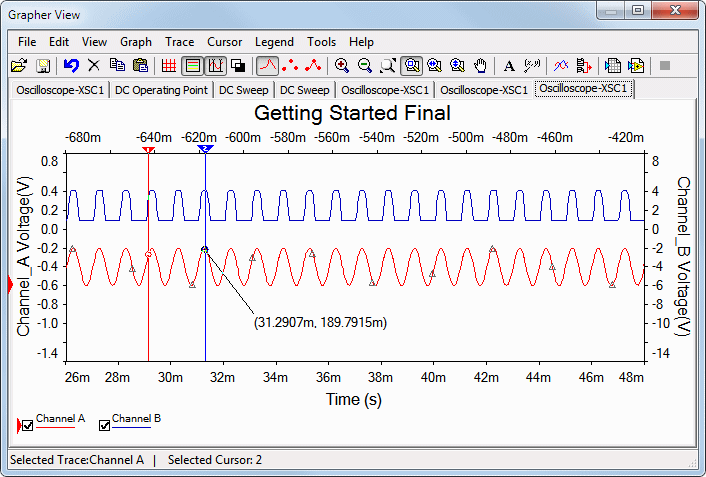
Data Labels - Multisim Help - National Instruments
Boolean Indexing in Pandas - GeeksforGeeks In boolean indexing, we will select subsets of data based on the actual values of the data in the DataFrame and not on their row/column labels or integer locations. In boolean indexing, we use a boolean vector to filter the data. ... In order to access a dataframe with a boolean index using .loc[], we simply pass a boolean value (True or False ...

Indexing and Slicing Python Pandas DataFrame – All About AI-ML
Sorting a DataFrame by index in Pandas - SkyTowner Adding a column that contains the difference in consecutive rows Adding a constant number to DataFrame columns Adding an empty column to a DataFrame Adding column to DataFrame with constant values Adding new columns to a DataFrame Appending rows to a DataFrame Applying a function that takes as input multiple column values Applying a function to a single column of a DataFrame Changing column ...

How to add User1-User20 to wire label report - Autodesk Community
Pandas DataFrame: set_index() function - w3resource The set_index() function is used to set the DataFrame index using existing columns. Set the DataFrame index (row labels) using one or more existing columns or arrays of the correct length. The index can replace the existing index or expand on it. Syntax: DataFrame.set_index(self, keys, drop=True, append=False, inplace=False, verify_integrity=False)
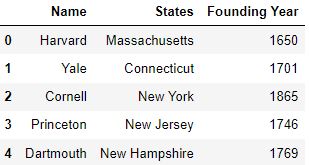
Pandas drop columns using dataframe.drop and all other methods ...
Using Pandas Index - Machine Learning, Deep Learning, and Computer Vision # we can use the index to select values from the series # this is similar to .loc for DataFrame # because series does not have multiple columns, we can do this drinks. continent ... column concatenation # beauty of automatic alignment using index pd. concat ([drinks, people], axis = 1). head Out[55]: beer_servings spirit_servings wine_servings ...
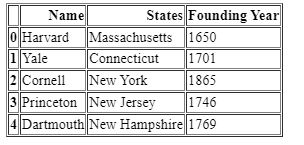
Pandas drop columns using dataframe.drop and all other methods ...
How to Filter Pandas DataFrame Based on Index - Data to Fish Filter Pandas DataFrame Based on the Index. Let's say that you want to select the row with the index of 2 (for the 'Monitor' product) while filtering out all the other rows. In that case, simply add the following syntax to the original code: df = df.filter (items = [2], axis=0) So the complete Python code to keep the row with the index of ...
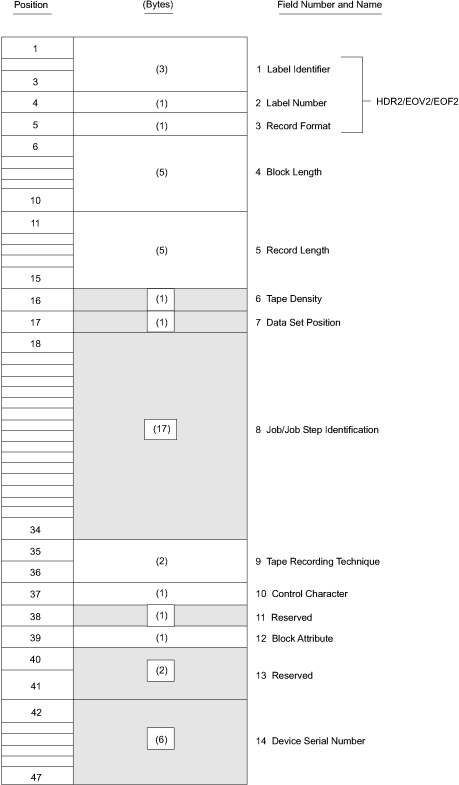
Format of IBM standard data set label 2 (HDR2/EOV2/EOF2)
What does the pandas DataFrame.index attribute do? A DataFrame is a pandas data structure that is used to store the labeled data in a two-dimension, the labels can be anything like text data, integer values, and time sequence. by using these labels we can access elements of a given DataFrame and we can do data manipulations too.
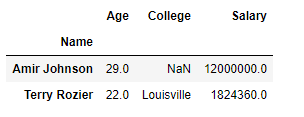
Indexing and Selecting Data with Pandas - GeeksforGeeks
Indexing and Selecting Data with Pandas - GeeksforGeeks Output: Indexing a DataFrame using .loc[ ]: This function selects data by the label of the rows and columns. The df.loc indexer selects data in a different way than just the indexing operator. It can select subsets of rows or columns. It can also simultaneously select subsets of rows and columns.
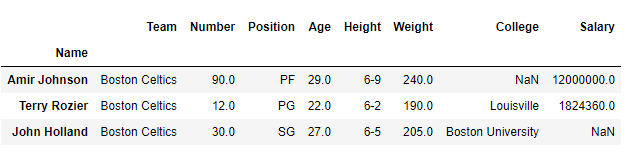
Indexing and Selecting Data with Pandas - GeeksforGeeks
python - Pandas: Iterate through columns index/labels and group the ... To select the columns that start with regex pattern Q[0-9], you can use df.filter() with regex= parameter, as follows:; df2 = df.filter(regex=r'^Q[0-9]') Regex meta-character ^ indicates matching start of text (column label). Then, to create a lookup table (in form of a Python dictionary) to lookup results of every Qx, you can use the dict comprehension to iterate through the Pandas GroupBy ...
KB36266: Documents containing graphs with rotated data labels display ...

Using iloc, loc, & ix to select rows and columns in Pandas DataFrames ...

Grouping Dynamic Application Data Using Collection Labels
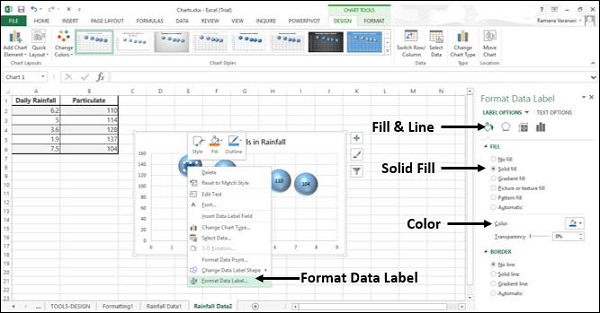
Module1
Post a Comment for "45 indexing using labels in dataframe"